Get Started
Overview
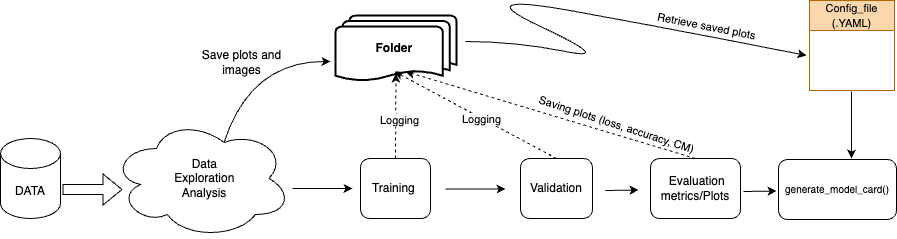
Given a dataset, we perform the exploratory data analysis (EDA). We store the visualization plots into a folder which will be further populated with the plots (loss, accuracy, confusion matrix e.t.c ) after model´s training and validation process is completed. The attributes The pipeline for generating the model card is shown in the fiugure below.
Start with the dataset
For demonstration purpose, we use the training pipeline of deep learning model and the FACED dataset that is supported by TorchEEG https://torcheeg.readthedocs.io/en/latest/. FACED dataset can be downloaded from the link https://www.synapse.org/#!Synapse:syn50614194/files/. Online preprocessing are applied as shown below after converting it into tensors and then fed to neural network as input.
Setting up the pipeline for generating model card
We initialize the TSception model and define its hyperparameters. Next, we configure the training and validation processes using PyTorch . After completing these steps, we employ a custom plotting function to generate and save plots for accuracy, loss, and the confusion matrix in the designated folder. Finally, we invoke the generate_model_card() function, which requires the path to the YAML config file, the output path for saving the model card, and the model card’s version number. The template of the config file is here.
from torch.utils.data import DataLoader
import torch
import torch.nn as nn
import torch.optim as optim
import torch.nn.functional as F
from sklearn.metrics import ConfusionMatrixDisplay
from tqdm import tqdm
import matplotlib.pyplot as plt
from sklearn.metrics import precision_score, recall_score,accuracy_score, f1_score, confusion_matrix
import seaborn as sns


from torch.utils.data import DataLoader, random_split
from torcheeg.datasets import FACEDDataset
from torcheeg import transforms
from torcheeg.datasets.constants import FACED_CHANNEL_LOCATION_DICT

from torcheeg.models.cnn import TSCeption
import json
import os
import time
from dreams_mc.make_model_card import generate_modelcard


data_folder= "./processed_data_Face/Processed_data"

dataset = FACEDDataset(root_path=data_folder,
                   online_transform=transforms.Compose(
                       [transforms.ToTensor(),
                        transforms.To2d()]),
                   label_transform=transforms.Compose([
                       transforms.Select('valence'),
                       transforms.Lambda(lambda x: x + 1)
                   ]))

# dataloaders
train_size = 0.8
batch_size = 32

num_train_samples = int(len(dataset) * train_size)
num_val_samples = len(dataset) - num_train_samples

# Split the dataset
train_dataset, val_dataset = random_split(dataset, [num_train_samples, num_val_samples])

# Create DataLoaders
train_loader = DataLoader(train_dataset, batch_size=batch_size, shuffle=True)
val_loader = DataLoader(val_dataset, batch_size=batch_size, shuffle=False)

#Initiate the model
model = TSCeption(num_classes=9,
              num_electrodes=30,
              sampling_rate=250,
              num_T=15,
              num_S=15,
              hid_channels=32,
              dropout=0.5)

device= torch.device( "cuda" if torch.cuda.is_available() else "cpu")

#computing accuracy
def compute_accuracy(y_pred, y_true):
    # Get the predicted class by selecting the maximum logit (log-probability)
    _, y_pred_tags = torch.max(y_pred, dim=1)

    # Compare predictions with true labels
    correct_pred = (y_pred_tags == y_true).float()

    # Compute accuracy
    acc = correct_pred.sum() / len(correct_pred)
    return acc


# Training  and validation function


def train(n_epochs, val_acc_max_input, model, optimizer, criterion, scheduler, train_loader, val_loader, checkpoint_path, best_model_path, start_epoch=1):
    val_acc_max = val_acc_max_input
    accuracy_stats = {'train': [], 'val': []}
    loss_stats = {'train': [], 'val': []}

    for e in tqdm(range(start_epoch, n_epochs + 1)):
        # TRAINING
        train_epoch_loss = 0
        train_epoch_acc = 0
        model.train()
        for X_train_batch, y_train_batch in train_loader:
            X_train_batch, y_train_batch = X_train_batch.to(device), y_train_batch.to(device)
            optimizer.zero_grad()
            y_train_pred = model(X_train_batch)
            train_loss = criterion(y_train_pred, y_train_batch)
            train_acc = compute_accuracy(y_train_pred, y_train_batch)

            train_loss.backward()
            optimizer.step()


            train_epoch_loss += train_loss.item()
            train_epoch_acc += train_acc.item()

        # VALIDATION
        with torch.no_grad():
            val_epoch_loss = 0
            val_epoch_acc = 0
            model.eval()
            for X_val_batch, y_val_batch in val_loader:
                X_val_batch, y_val_batch = X_val_batch.to(device), y_val_batch.to(device)
                y_val_pred = model(X_val_batch)
                val_loss = criterion(y_val_pred, y_val_batch)
                val_acc = compute_accuracy(y_val_pred, y_val_batch)

                val_epoch_loss += val_loss.item()
                val_epoch_acc += val_acc.item()

        loss_stats['train'].append(train_epoch_loss / len(train_loader))
        loss_stats['val'].append(val_epoch_loss / len(val_loader))
        accuracy_stats['train'].append(train_epoch_acc / len(train_loader))
        accuracy_stats['val'].append(val_epoch_acc / len(val_loader))

        valid_accuracy = val_epoch_acc / len(val_loader)

        print(f'Epoch {e:03}: | Train Loss: {train_epoch_loss / len(train_loader):.5f} | Val Loss: {val_epoch_loss / len(val_loader):.5f} | Train Acc: {train_epoch_acc / len(train_loader):.3f} | Val Acc: {val_epoch_acc / len(val_loader):.3f}')

        scheduler.step(val_epoch_loss / len(val_loader))

        # Create checkpoint variable and add important data
        checkpoint = {
            'epoch': e + 1,
            'valid_acc_max': valid_accuracy,
            'state_dict': model.state_dict(),
            'optimizer': optimizer.state_dict(),
        }
        save_ckp(checkpoint, False, checkpoint_path, best_model_path)

        if valid_accuracy > val_acc_max:
            print(f'Validation accuracy increased ({val_acc_max:.6f} --> {valid_accuracy:.6f}).  Saving model ...')
            save_ckp(checkpoint, True, checkpoint_path, best_model_path)
            val_acc_max = valid_accuracy

    return model, accuracy_stats, loss_stats


class_names = ['Negative', 'Neutral', 'Positive']
device = torch.device("cuda" if torch.cuda.is_available() else "cpu")


optimizer = optim.Adam(model.parameters(), lr=0.001, weight_decay=1e-4)
#scheduler = optim.lr_scheduler.CyclicLR(optimizer, base_lr=1e-6, max_lr=0.01)
scheduler = optim.lr_scheduler.ReduceLROnPlateau(optimizer, mode='min', factor=0.1, patience=10, verbose=True)

criterion = nn.CrossEntropyLoss()

# Model Training
valid_acc_max = 0.0
trained_model, accuracy_stats, loss_stats = train(220, valid_acc_max, model, optimizer, criterion, scheduler, train_loader, val_loader, "./logs/current_checkpoint.pt", "./logs/best_model.pt", start_epoch=1)
# plotting and saving training and validation plots
plot_training_validation_stats(accuracy_stats, loss_stats, save_dir='./logs')

# Load the best model for evaluation
checkpoint_path = './logs/best_model.pt'
checkpoint = torch.load(checkpoint_path, map_location=torch.device('cpu'))
model.load_state_dict(checkpoint['state_dict'])

# Evaluate the model and saving the required  plots
results = evaluate_model(model=model, data_loader=val_loader, device=device)
plot_metrics_table(results, model_name='TSception',save_path="./logs/table.png")
plot_confusion_matrix(results['confusion_matrix'], class_names,save_path="./logs/cm.png")
plot_confidence_intervals(precision=results['precision'], recall=results['recall'],
                          accuracy=results['accuracy'], f1=results['f1_score'],
                          n=len(val_loader.dataset), save_path="./logs/CI_plot.png",
                          confidence=0.95)

# Generating model card
print("Generating Model Card....")
config_file_path = './config.yaml'
output_path = './logs/model_card.html'
version_num = '1.0'
generate_modelcard(config_file_path, output_path, version_num)